
Chemicals found in plastics, such as BPA, phthalates, and PFAS, act as artificial oestrogens in the body, severely disrupting hormones, the brain, and metabolism—even in very small quantities. Constant exposure to plastics, tin packaging, air pollution, and household chemicals creates a cumulative burden that affects the body’s overall balance. People are living in survival mode rather than enjoying life. Read this in-depth scientific article based on the expertise of Annika Urm, an entrepreneur with a master’s degree in medical education and a lifestyle coach. Plastic is not just packaging; it is a complex chemical system. Substances are deliberately added to make it soft, flexible, and durable—and these additives pose a major health risk. Read on to discover what synthetic oestrogen is, how it affects your hormones and brain, and view the list of health issues directly linked to food packaging.
How artificial oestrogen in plastic packaging disrupts your hormones and your brain

Substances found in plastics, such as BPA and phthalates, act as artificial oestrogens, directly disrupting your endocrine balance. Crucially, this effect occurs even at minute, micro-level quantities—far below official “safe” legal limits.
In the retail sector, food packaging and sold food items are linked to more than 100 serious health conditions. These represent systemic categories of disease rather than isolated illnesses:
- Hormonal Disorders
- Oestrogen dominance
- Thyroid disorders
- General hormonal imbalances
- Fertility and Reproductive Health
- Male and female infertility
- Decline in sperm quality
- Menstrual cycle disruptions
- The Brain and Nervous System
- Anxiety
- ADHD
- Memory impairment
- Neurodevelopmental disorders
- Metabolism and Chronic Diseases
- Obesity
- Type 2 diabetes
- Metabolic syndrome
- Cancer
- Breast cancer
- Prostate cancer
- Thyroid cancer
- Liver cancer
- Immune System
- Autoimmune diseases (e.g., Hashimoto’s thyroiditis)
- Chronic systemic inflammation
- Cardiovascular System
- High blood pressure (hypertension)
- Heart disease
What Is the Artificial Oestrogen Found in Plastic?
Plastic is far more than just a single material; it is a chemical mix formulated with additives to make products soft, flexible, durable, and inexpensive to manufacture.
Common Chemical Additives:
- BPA (bisphenol A)
- Phthalates
- PFAS compounds (“forever chemicals”)
- PCBs and pesticide residues
Many of these compounds act as Endocrine Disrupting Chemicals (EDCs) in the human body. This means they:
- Mimic natural hormones (particularly oestrogen).
- Block essential hormone receptors.
- Alter the body’s natural production and breakdown of native hormones.
What Is Actually Happening Inside Your Body
The human body relies entirely on hormones for systemic communication. These chemical messengers deliver explicit signals to cells regarding:
- Energy production and metabolic rates.
- Growth, tissue repair, and physical recovery.
- Cognitive processing and neurological function.
- Reproductive capabilities and fertility.
When a synthetic compound mimicking a hormone enters the bloodstream, the body cannot distinguish it from a natural hormone. BPA binds directly to oestrogen receptors, broadcasting false chemical signals throughout the body. Phthalates, meanwhile, block testosterone activity and disrupt normal physical development.
This does not result in a minor, isolated effect—it causes a systemic breakdown of cellular communication.
Why Does Plastic Become Soft—and Why Is This Dangerous?
Plastic does not become flexible naturally. Manufacturers blend in phthalates to grant flexibility to items like water bottles, food containers, and cosmetics packaging.
These additives are not chemically bound to the plastic matrix and easily leach into your body through food, drinking water, and skin absorption. Heat, dietary fats, and storage duration significantly accelerate this chemical migration.
The Internal Cascade:
- The body misidentifies these leached chemicals as natural oestrogen.
- The endocrine system receives inaccurate regulatory signals.
- Homeostasis and systemic balance are completely disrupted.
How Exposure Affects the Brain and Nervous System
When the endocrine system receives distorted signals, the biological consequences extend far beyond basic hormone counts. Hormones directly regulate neurological operations, including neurotransmitter activity, synaptic development, and neural network formation.
When BPA and phthalates accumulate in the body:
- Neurotransmitter balance is altered.
- Brain development is disrupted (especially during early developmental stages).
- Emotional processing and executive behaviour are modified.
Clinical studies link this exposure to:
- Elevated anxiety levels.
- Concentration difficulties and focus impairment.
- Reduced learning capacity.
- Chronic memory deficits.
This impact is rarely instantaneous; it represents a gradual, cumulative shift that occurs as the nervous system is subjected to constant, incorrect hormonal signaling over extended periods.
Effects on the Thyroid, Metabolism, and Energy Levels
Beyond reproductive signaling, these environmental chemicals target the thyroid gland, which controls the body’s baseline metabolic rate.
BPA, Phthalates, and PFAS Compounds:
- Disrupt the production of thyroid hormones (T4 and T3).
- Impair hormone transport proteins in the bloodstream.
- Reduce cellular receptor sensitivity to thyroid signals.
- Interfere with the peripheral conversion of T4 into active T3.
This often manifests not as a clear-cut, diagnosable medical condition, but as a functional disorder where the body fails to operate at peak capacity.
Common Manifestations:
- Chronic physical fatigue
- Sluggish metabolism
- Cold intolerance
- Persistent “brain fog”
- Unexplained weight gain or difficulty losing weight
The thyroid gland is particularly vulnerable to environmental toxins because it concentrates iodine and relies on dense blood circulation. Consequently, many individuals feel unwell despite their standard blood test results falling within conventional “normal” reference ranges.
Key Nutrients Required for Thyroid Function
Reducing EDC exposure is only half the battle; the thyroid also requires targeted nutritional support to manufacture hormones, convert them efficiently, and maintain receptor sensitivity.
- Selenium: Essential for converting T4 into active T3 while simultaneously protecting thyroid tissue from oxidative damage.
- Iodine: A fundamental structural building block for thyroid hormones. Without adequate iodine, the body cannot synthesize T4 or T3, regardless of overall system health.
- Zinc: Supports hypothalamic TRH signaling, enhances thyroid hormone receptor sensitivity, and ensures appropriate tissue response to circulating hormones.
A deficiency in selenium, iodine, or zinc further depresses thyroid output, particularly when the body is already burdened by endocrine disruptors.
Impact on Female Hormones and Fertility
The female hormonal system is exceptionally sensitive to oestrogen-mimicking compounds due to its reliance on a precise balance between oestrogen and progesterone. Disrupting this equilibrium affects the entire reproductive system.
BPA acts as supplemental oestrogen, frequently triggering oestrogen dominance—a state where oestrogen activity far outweighs progesterone. This directly destabilizes the menstrual cycle, ovulation patterns, and overall fertility.
Potential Outcomes:
- Irregular menstrual cycles
- Ovulatory dysfunction
- Reduced overall fertility
- Exacerbated PMS symptoms and severe mood swings
These chemicals also disrupt the hypothalamic–pituitary–ovarian (HPO) axis, scrambling crucial signaling pathways between the brain and ovaries. Exposure during fetal development or early childhood can permanently alter reproductive organ development and long-term hormonal balance.
Impact on Men: Testosterone Depletion and Development
While endocrine disruption is often framed as a women’s health issue, these compounds pose severe risks to men. Phthalates act as antiandrogens, directly suppressing testosterone activity in the body.
Potential Consequences for Men:
- Marked decline in total testosterone levels
- Reduced sperm count and motility
- Decreased libido
- Loss of physical energy and lean muscle mass
When male exposure occurs during early developmental windows, it can impair structural reproductive growth. In adulthood, it typically presents as a slow, continuous degradation of hormonal vitality.
The Cumulative Burden: The “Mixture Effect”
Humans are never exposed to just one chemical at a time. Every day, exposure occurs across multiple overlapping vectors:
| Exposure Vector | Examples |
| Food Packaging | Plastic containers, lined tin cans, cling film |
| Personal Care | Cosmetics, synthetic fragrances, lotions |
| Household Items | Chemical cleaners, air fresheners, detergents |
| Environment | Tap water, agricultural produce, indoor and outdoor air |
While an isolated dose of a single chemical might be small, daily exposure creates a severe cumulative hormonal burden. The human body does not process these chemicals in isolation; it reacts to the entire “cocktail” simultaneously.
Key Features of Cumulative Exposure:
- Non-linear impact: Low doses can produce disproportionately large biological effects.
- Bioaccumulation: Chemical burdens build up over time.
- Synergistic toxicity: The combined impact of multiple EDCs is often significantly greater than the sum of its individual parts.
How Body Systems Interconnect
Hormones do not act independently. Sex hormones, the thyroid gland, the brain and the immune system are directly linked. If one part is disrupted, the impact is felt in other systems as well.
For example:
- thyroid disorder → slower metabolism → change in hormone balance
- oestrogen dominance → inflammation → strain on the nervous system
- chronic exposure to chemicals → immune system dysfunction → hormonal imbalance
This means that the problem is never just ‘one hormone’, but rather a loss of balance in the whole system.
A single “isolated hormone issue” rarely exists—chemical exposure leads to a systemic loss of physiological balance.
Why “Safe Legal Limits” Are Misleading
Endocrine disruptors do not follow traditional toxicological rules where “the dose makes the poison.” Natural hormones regulate physiological pathways at extremely low concentrations; synthetic hormone mimics act identically at the micro-level.
- Low doses can trigger major changes in hormonal signaling.
- The timing of exposure (e.g., gestation, early childhood, puberty) is often more critical than the sheer volume of the dose.
- Long-term, low-dose exposure causes greater metabolic disruption than a single acute exposure.
Consequently, legal threshold levels categorized as “safe” can still remain biologically active and harmful inside the human body.
Teflon Cookware and PFAS: An Invisible Hormonal Threat
Beyond plastic packaging, non-stick cookware coated with Teflon is a major, underreported source of hormonal disruption. These coatings rely on PFAS (per- and polyfluoroalkyl substances)—indestructible chemicals that resist environmental degradation and bioaccumulate in human tissue.
When non-stick pans are heated to high temperatures or their surface coatings become worn, PFAS compounds volatilize into the air and leach into cooked food.
How PFAS Affects the Body:
- Disrupts thyroid hormone balance by altering T3 and T4 ratios.
- Binds to transport proteins in the blood, blocking natural hormone availability to cells.
- Drives systemic oxidative stress and chronic inflammation.
- Impairs fertility and suppresses normal immune responses.
Because the body excretes PFAS very slowly, daily micro-exposures from non-stick cookware compound over time into a significant biological burden.
Tin Canned Packaging: Hidden Risks of Long-Term Storage
Tin cans (TIN) used for canned fish, beans, soups, and vegetables present a distinct chemical risk. Metal packaging is not chemically inert; the inner walls of cans are lined with protective resins or varnishes that typically contain BPA or its functional analogs.
Chemical Risks of Long-Term Canned Storage:
- Chemical Migration: Acidic or fatty foods react with internal synthetic linings, accelerating chemical migration into the food.
- Trace Metal Leaching: Worn or damaged inner coatings expose food directly to underlying aluminum or tin.
- Lipid Oxidation: Prolonged shelf storage oxidizes fats—especially in canned fish—generating harmful oxidative compounds.
- Preservation vs. Neutrality: A long shelf life guarantees microbiological safety, but it does not ensure chemical or hormonal neutrality.
Over months or years on a shelf, continuous contact between the food and inner resin linings increases EDC concentration.
Actionable Canned Food Guidelines:
- Prioritize fresh or frozen whole foods over canned goods.
- If purchasing canned items, verify that the packaging is explicitly BPA-free and consume them promptly.
- Avoid relying on canned foods as a daily diet staple.
Air Pollution and Environmental Toxins
Airborne pollutants act as pervasive environmental endocrine disruptors that enter the bloodstream directly via respiration.
Inhaled Pollutants:
- Fine particulate matter (PM2.5 and PM10)
- Nitrogen dioxide (NO2) and ground-level ozone (O3)
- Airborne heavy metals (lead, mercury, cadmium)
- Volatile agricultural pesticides
Impact on Thyroid and Hormones
Due to its high vascularity and reliance on iodine uptake, the thyroid gland easily absorbs airborne toxins:
- PM2.5 particles physically damage thyroid follicular cells, impairing hormone synthesis.
- NO2 and ozone disrupt feedback loops between the brain and the thyroid gland.
- Heavy metals block hormone receptors and alter normal cellular responses.
This atmospheric load manifests as elevated TSH levels (indicating the thyroid is struggling to keep up), unbalanced T3/T4 ratios, sluggish metabolism, and chronic low energy. It can also trigger autoimmune conditions like Hashimoto’s or Graves’ disease.
Pesticides and Household Cleaners
Agricultural pesticides (organophosphates, synthetic herbicides, fungicides) and home cleaning chemicals are engineered specifically to alter biological systems.
Agricultural Pesticides: Regular intake of pesticide residues via non-organic food creates low-grade, constant exposure. Pesticides inhibit thyroid hormone production, block enzymatic pathways required for hormone synthesis, and reduce cellular receptor sensitivity.
Household Cleaners and Personal Care: Cleaning agents, air fresheners, laundry products, and cosmetics frequently contain phthalates and synthetic fixatives disguised under generic ingredient terms like “fragrance” or “parfum”. These compounds enter the body via dermal absorption and inhalation, driving continuous baseline inflammation and hormonal instability.
When combined with plastics, non-stick cookware, and air pollution, these household products overload the body’s adaptive capacity.
How the Body Eliminates Endocrine Disruptors
The human body possesses innate biological mechanisms to break down and excrete environmental toxins. However, modern exposure levels frequently exceed natural elimination rates.
Detoxification is not a commercial product, a juice fast, or a powder—it is an ongoing biological process executed by the liver, gut, kidneys, lymphatic system, and skin.
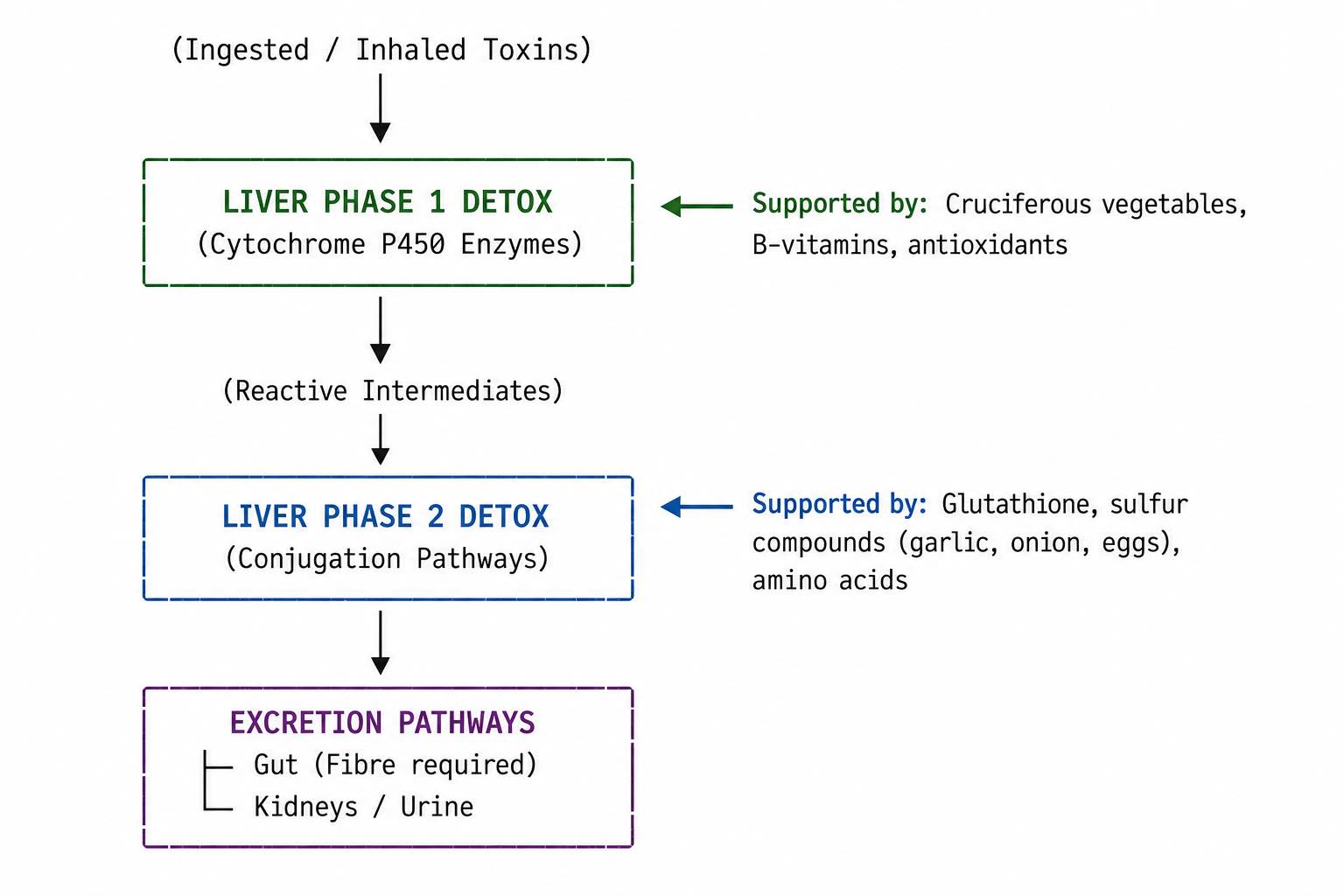
Phase 1 Liver Detox: Chemical Processing
Using cytochrome P450 enzymes, the liver chemically modifies lipid-soluble toxins. This initial step creates intermediate compounds that are often more reactive than the original toxin. Phase 1 requires robust antioxidant protection, B vitamins, and compounds found in cruciferous vegetables (broccoli, cabbage, kale, Brussels sprouts) to prevent metabolic bottlenecks.
Phase 2 Liver Detox: Neutralization and Binding
During Phase 2, the liver binds (conjugates) these reactive intermediates with specific molecules to render them water-soluble and safe for excretion. Glutathione is the central protective molecule for this phase.
Phase 2 requires sulfur-rich foods (garlic, onions, eggs), avocados, and adequate dietary protein for amino acid supply. If Phase 1 operates faster than Phase 2, toxic intermediates accumulate, exacerbating oxidative tissue damage.
Metabolic Pathways and Hormonal Support
Because BPA, phthalates, and PFAS mimic oestrogen, the liver must process them using the exact same pathways reserved for endogenous hormones.
- DIM (Diindolylmethane): Supports healthy oestrogen metabolism by encouraging conversion into less reactive metabolites, though it cannot compensate for an overloaded Phase 2 liver process or insufficient glutathione.
- Thyroid Regulation: Thyroid hormones set the overall metabolic rate for liver detoxification. Optimal levels of selenium, iodine, and zinc are crucial for maintaining efficient processing speeds.
The Role of the Gut, Kidneys, and Lymphatic System
Once processed by the liver, toxic metabolites are routed to the intestines via bile or to the kidneys via blood.
- The Gut: High dietary fibre is essential to bind waste products in the stool. Without adequate fibre, metabolized EDCs can be reabsorbed back into circulation through the intestinal wall (enterohepatic circulation).
- Kidneys and Hydration: Water-soluble metabolites require consistent daily water intake for efficient urinary excretion.
- Lymphatic Movement: The lymphatic system transports cellular waste out of tissues into circulation. Because the lymphatic network lacks a central pump, it relies on physical muscle movement, exercise, and sweating to maintain flow.
Actionable Steps: Reducing Your Everyday Burden
You cannot control global environmental pollution, but you can dramatically reduce your personal daily exposure by modifying your home environment and lifestyle habits.
1. Kitchen and Food Storage
- Never heat food in plastic: Heat dramatically accelerates chemical leaching into food. Always use glass, ceramic, or stainless steel containers for heating and storing food.
- Upgrade drinkware: Avoid plastic water bottles—especially when exposed to warmth. Use glass or stainless steel bottles, and use a high-quality home water filter to reduce PFAS and heavy metals.
- Swap non-stick cookware: Replace worn Teflon or non-stick pans with cast iron, stainless steel, or 100% ceramic cookware.
- Prioritize whole foods: Choose fresh or frozen produce over canned items. Select high-quality, organic proteins and wild-caught fish when possible to minimize bioaccumulated toxins.
2. Personal Care and Household Hygiene
- Eliminate synthetic fragrances: Avoid products listing generic “fragrance” or “parfum.” Opt for fragrance-free or naturally derived cleaning and personal care products.
- Minimize paper receipt handling: Thermal receipts are heavily coated with unbound BPA/BPS, which absorbs rapidly through the skin. Choose digital receipts when possible and wash your hands after handling printed receipts.
3. Targeted Nutritional Support
- Cruciferous & Sulfur-Rich Foods: Incorporate broccoli, cabbage, kale, garlic, onions, and eggs to fuel Phase 1 and Phase 2 liver pathways.
- Key Minerals: Consume Brazil nuts (selenium), seaweed and seafood (iodine), and pumpkin seeds or oysters (zinc) to support thyroid function.
- Protein & Fibre: Maintain adequate protein intake to support glutathione synthesis, and eat plenty of dietary fibre to prevent intestinal reabsorption of processed toxins.
- Hydration: Sip clean water steadily throughout the day to support kidney excretion.
4. Lifestyle and Environment
- Prioritize Movement & Sweating: Daily walking, physical exercise, and sauna usage stimulate lymphatic drainage and support natural excretion pathways.
- Improve Indoor Air Quality: Ventilate living spaces regularly, use range hoods while cooking, and spend time in clean, natural outdoor environments.
- Manage Stress & Sleep: Chronic stress keeps the body in a continuous “survival mode,” suppressing repair and detoxification processes. Maintain a consistent sleep routine, maximize natural morning sunlight, and minimize artificial light exposure at night to preserve baseline endocrine balance.
Summary
Chemicals found in plastics—including BPA, phthalates, and PFAS—are active endocrine disruptors that mimic natural oestrogen, interfering with thyroid health, reproductive function, metabolism, and brain signaling. Because we face simultaneous daily exposure across food packaging, cosmetics, household products, and air pollution, these low-dose exposures create a powerful cumulative burden.
While you cannot eliminate every environmental exposure, taking targeted steps at home—eliminating plastic food heat exposure, avoiding synthetic fragrances, choosing clean cookware, and supporting your liver and thyroid with proper nutrition—gives your body the leverage it needs to maintain long-term hormonal balance.
Author Annika Urm – Annika Urm is a financial manager with a master’s degree, whose background is in accounting and management, and who developed a deep understanding of the logic of balance and equilibrium. While studying medical nursing, she discovered that the human body functions on the same principle as a financial balance sheet: health does not depend on individual indicators, but rather on whether the system is in balance.
Annika focuses on the human body as a whole, in which fluid balance, electrolytes, acid-base balance, vitamins, minerals, hormones, and metabolism all play a key role.
Annika takes a systematic approach to health—looking at both test results and the person behind them, and always asking what the body is lacking, what it has in excess, and how to restore balance.
This approach is particularly evident in intensive care, where the patient is unable to speak, and decisions are made based on physiology, test results, and clinical logic. For Annika, this is not an exceptional situation, but a reflection of the fact that everyone’s health ultimately boils down to the same principle—the body’s balance.
In restoring balance, he also considers the regulation of the nervous system and metabolism to be important, where sleep, physical activity (especially strength training), adherence to the circadian rhythm, and the alternation between cold and heat play a central role as physiological signals that teach the body to adapt and recover. In his view, these are not “lifestyle tips,” but rather part of the body’s biological regulation and mechanisms for maintaining health.
In addition to nursing, Annika explores the ketogenic diet as one possible tool for supporting metabolic balance, but her primary interest and passion have always been the same: human health and the body’s ability to heal itself when that balance is in place.
For more information about Annika Urmi, click here:
AU News today https://news.annikaurm.com/
Annika Urm https://annikaurm.com/
Annika Urm – Your Guide to a Healthy Lifestyle
Annika is the creator of Golden Stevia recipes, cookbooks, and a nutrition consultant specializing in keto and low-carb diets, with a focus on low-carb, keto, and diabetes-friendly nutrition. Her approach combines science-based nutrition, practical living, and natural balance
Read more:


