
If you really want to become healthier, you need to change your home, your kitchen, your workplace, and the people around you. If you want to truly change, start by changing your environment. Health begins with what you allow into your home. If your home is full of sugar, your body cannot become healthy. Giving up sugar starts in the kitchen, at the shop, and with the people around you. Your environment shapes your habits: how to really start a low-carb and keto lifestyle.
The environment doesn’t allow for change: why low-carb and keto diets start at home
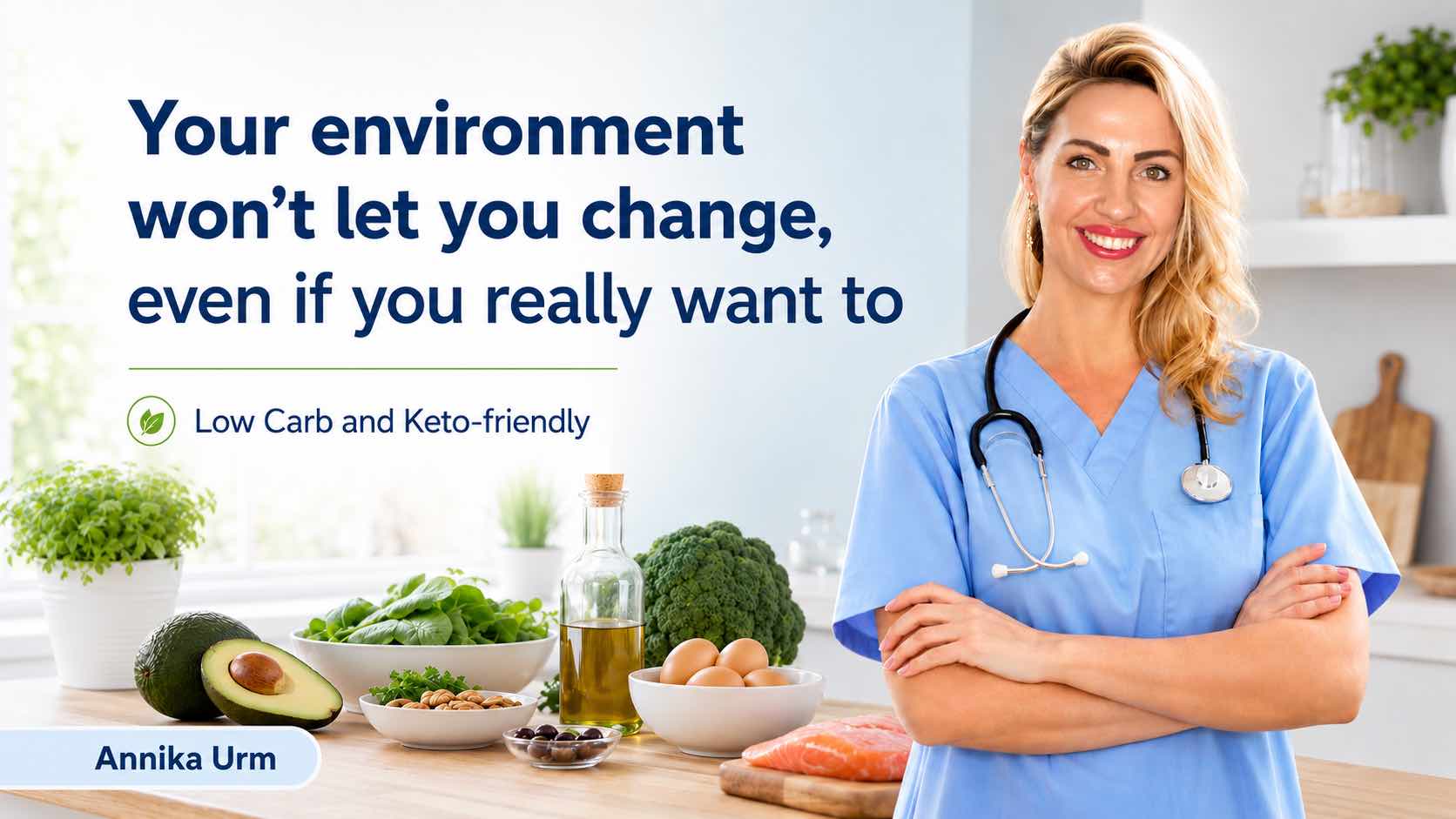
“Low Carb and Keto diets start at home” – Annika Urm
Steps to take before you start
- Clear your home of ultra-processed foods: get rid of sugar, bread, wheat flour, rice flour, starch, biscuits, crisps, snack bars, sweet drinks, breakfast cereals, rapeseed oil, cheap vegetable oils, ready meals and any snacks bought ‘just in case’.
- Don’t leave food out in the open: the kitchen table doesn’t have to be a constant reminder to eat. When food is in sight, the brain begins to react to it even if the body isn’t actually hungry.
- Stop snacking all the time: eat proper meals. If you’re really hungry, eat proper food: eggs, meat, fish, broth, cheese, quark or other low-carb/keto-friendly foods.
- Prepare your healthy alternatives in advance: when you cut out sugar and bread, create a whole new world to replace them — keto bread, sugar-free low-carb desserts, eggs, meat, fish, butter, olive oil, stock, collagen, mineral salt, berries, stevia and monk fruit. You can find all the instructions on the www.goldenstevia.com website, under the News category in Annika Urm’s articles; in the ‘Recipes’ category you’ll find recipes, and in the ‘Shop’ category you’ll find the ‘Sugar-Free’ books (yellow and red editions) and all the food you need from the Low Carb Keto online shop. You’ll find 24 different keto baking mixes, monk fruit, stevia, collagen/gelatine, and sea salts to be a great help. You can find cooking videos and lifestyle tips on the Golden Stevia YouTube channel: https://www.youtube.com/@goldenstevia
- Set up your own food supply system: find sources of eggs, dairy products, meat, liver, bones, berries and seasonal produce. Make your own jams, preserves, stocks, bread and proper food.
- Only go to the shops with a shopping list and a full stomach: the shop isn’t a place of entertainment, but a place where the food industry tries to steer what you put in your shopping basket.
- Keep the kitchen closed between meals: the kitchen is closed after dinner. Not ‘just a little nibble’, not a peek in the fridge, not slices of cheese, nuts or quark eaten with a spoon.
- Get enough sleep and minimise your exposure to blue light in the evening: poor sleep makes cravings worse the following day. Light/sunrise in the morning, darkness in the evening, sleep at night.
- Plan ahead for social events: eat beforehand, take your own food with you, don’t stand by the buffet table and, if possible, organise the party yourself.
- Surround yourself with people and situations that support your change: if the people around you mock your health choices, bring sugar into your home and try to push you back into your old way of life, then that is not a neutral environment. That’s the environment that doesn’t allow you to change.
“Willpower isn’t enough when your environment is working against you. Why can’t you give up sugar? Because your environment won’t let you. Low-carb and keto start at home, not with willpower. You don’t need more willpower. You need a new environment.”
Many people believe that becoming healthy starts with willpower. It is commonly believed that if a person cannot give up sugar, bread, snacking, eating in the evening, or a constant craving for sweet things, then they are simply weak. This is one of the biggest lies that today’s food industry feeds people. The real problem is usually not that a person lacks willpower. The real problem is that their environment is working against them. If your cupboards at home are full of bread, biscuits, chocolate bars, crisps, breakfast cereals, sweets, fruit juices, sweet yoghurts and snacks bought ‘just in case’, then you are not living in a neutral environment. You are living in an environment that is constantly tempting you to eat. If food is in plain sight, if there are reserves in the cupboard, if the fridge is full of sweets bought ‘for the children’, if there’s a bowl of sweets on your desk and a cake is brought in at work for every birthday, then you’re not just fighting hunger. You’re fighting against your home, your habits, your dopamine system, your family, your workplace and the entire modern food industry.
In his video “My Biggest Health Mistake (I Hid This for Years)”, Dr Eric Berg explains very clearly that his biggest mistake was not just a poor diet, but a poor environment. The video description highlights the topics “Environment and the processed food diet” and “How to quit sugar and junk food”. His key message is simple: people don’t fail because they don’t want to change, but because their surroundings are designed to keep them eating. In the video and the accompanying post, his steps are very specific: cut out ultra-processed food, stop snacking, don’t keep food in plain sight, find healthy alternatives, avoid blue light in the evening, shop wisely, prioritise sleep, and be cautious at social events.
This is exactly the same logic that Annika Urm has been teaching for years in relation to low- carb, keto and sugar-free living. Low-carb and keto aren’t just ‘diets’ where you have to pull yourself together for a short while. It’s a lifestyle that requires a change in your environment. If your environment stays the same, old habits will creep back in. If your home remains the same, if your family eats the same way, if your workplace still pushes sugar and pastries on you, and if all social occasions revolve around carbohydrates, then you can start over and over again, but you’ll eventually burn out. They don’t fail because they’re weak. They fail because they’re trying to swim against the tide.
Starting a sugar-free lifestyle doesn’t just mean not buying sweets. It means changing the whole system you live by: what you buy for your home, what you keep in plain sight, how you shop, what you take to work, how you handle birthdays, and the people with whom you share your change. Annika Urm has also written about this in her guide to starting a sugar-free life.
Why does the modern food environment make people ill?
People today no longer live in a natural food environment. They do not have to grow, gather, hunt, prepare or wait for food. Food is available all the time. It’s in the shop, at the petrol station, at work, at school, in adverts on your phone, at birthday parties, in the office, at home, in the fridge, in the cupboard, in the car and in your handbag. The problem isn’t just that there’s so much food. The problem is what sort of food it is.
Ultra-processed food is designed to be easy to overeat. It is no longer real food, but an industrial combination of sugar, starch, refined oils, flavour enhancers, aromas, textures and cheap fillers. This sort of food does not really satisfy the body. It sends a quick signal to the brain – dopamine – providing a momentary sense of pleasure, creating addiction and triggering a new craving quite quickly.
We no longer have to rely solely on experience to believe this. Scientific research has shown that ultra-processed food causes people to eat more and promotes weight gain. In a controlled study by the NIH (National Institutes of Health), participants were given either ultra-processed or minimally processed food to eat. Both menus were designed to be as similar as possible in terms of calories, sugar, fat, fibre and macronutrients, but during the ultra-processed food period, people consumed more calories and gained weight. During the period when minimally processed food was consumed, people ate less and lost weight. This means that it’s not just about the calories on paper, but also about the degree of food processing, the speed at which we eat, feelings of fullness, and how food affects human biology.
Annika Urm puts it very bluntly: “If you want to regain your health, avoid these foods like the plague: sugar, rapeseed oil, seed oils (yellow oils, oils in plastic bottles), wheat flour, starch, rice flour, and ultra-processed ready meals.” They are so commonplace in the everyday diet of modern people that people no longer even notice how ubiquitous they are: in bread, pastries, sauces, tinned soups, mayonnaise, ready meals, children’s food, snacks, breakfast cereals and ‘healthy’ bars.”
Annika Urm has also written about how sugar is not just a sweet taste, but a biological factor. Sugar affects blood sugar levels, insulin, appetite, the brain’s reward system and a person’s day- to-day choices. If a person lives in an environment where sugar is constantly available, then it is not simply a matter of free will.
If food makes you feel ill, tired, inflamed, hungry and dependent, then it is not the best medicine for you. Real food – the kind that comes from the farm, the garden, the forest, the sea, animals, the henhouse and your own kitchen – is a completely different matter. Annika Urm wrote about this principle in her article ‘Food is your best medicine’.
Low-carb and keto aren’t a punishment, but a change in your hormonal environment
Low-carb and keto don’t just mean ‘don’t eat sugar’. That’s an oversimplification. In fact, low-carb and keto mean that a person changes both their internal and external environments at the same time. Externally, your home, kitchen, shopping list, working day, social life and food preparation all change. Internally, your blood sugar, insulin levels, feelings of hunger, cravings, energy levels, fat burning and hormonal signals all change.
If a person constantly eats sugar, bread, pasta, potatoes, rice, biscuits, crisps, fruit juice and snacks, their body is subject to constant fluctuations in carbohydrates and insulin levels. When blood sugar rises, the body has to deal with it. When blood sugar falls, a new craving arises. And so, from morning till night, a person lives with food on their mind. They cannot understand why they’re constantly craving something, why their hand ‘just reaches out’ in the evening, why they still want something sweet after a proper lunch, why one sweet turns into ten, and why the phrase ‘I’ll start tomorrow’ is repeated year after year.
The American Diabetes Association’s 2019 consensus report states that low-carbohydrate and, in particular, very low-carbohydrate dietary patterns may reduce A1C levels and the need for blood glucose-lowering medication, and that these are among the most extensively studied dietary patterns in relation to type 2 diabetes. A systematic review published in the BMJ also found that a low-carbohydrate diet may help some people with type 2 diabetes achieve remission within six months, although one must be realistic about long-term maintenance and individual suitability.
That’s why a low-carb or keto diet can’t just be about ‘cutting out bread’. If you give up bread, sugar and pasta, but keep the same home, the same pressures at work, the same sweet drawer, the same shopping routine and the same family meals, then you’re still in the same old environment. Low-carb and keto diets really start to work when the healthy choice becomes the easiest choice. This is a particularly personal issue for Annika, as a member of her family has type 1 diabetes. If there is a diabetic in the household, or if a person is pre-diabetic themselves, then making changes on one’s own in a negative environment is not sustainable. In fact, the whole family should change. Not just a sick child, not just a mother, not just one person, but the whole home food environment. If a family member has diabetes and the Christmas dinner includes food high in carbohydrates, their blood sugar will be above normal, and their HI will be ‘high’ even before dessert.
That is precisely why Annika Urm wrote the book “SUHKRUVABA JÕULUD” (Sugar-Free Christmas), in which the entire Christmas menu is low in carbohydrates, gluten-free and sugar- free, so that the whole family can enjoy a healthy, low-carb meal together around the table. This book is also a helpful resource and guide for all people with diabetes. All the recipes contain less than 10 g of carbohydrates (hereinafter referred to as ‘carbs’) per 100 g. It’s hard to believe, even for someone who’s had diabetes for a long time – how is that possible? The brain simply refuses to accept this information. Tip – give it a go yourself! It is easy for a diabetic to check this by measuring their blood sugar.
The same principle is applied in Annika Urm’s first ‘SUHKRUVABA’ cookbook. It’s not just a book of desserts. It is a tool for changing the environment. If a person thinks they have to give up cakes, tarts, pancakes, burgers, pizza and bread for good, they feel as though something has been taken away from them. When you realise that these dishes can be made sugar-free, gluten-free, low-carb and keto-friendly, a whole new world opens up to you. The “SUHKRUVABA” I cookbook teaches you how to prepare sugar-free, gluten-free, low-carb, keto and diabetic meals, and the recipes include carbohydrate counts.
The first big step: clear your home of anything that holds you back
If a person really wants to change, the first honest question they need to ask themselves at home is: what food is actually around me? Not what I intend to eat on an ideal day, but what is actually in my cupboard, drawer, fridge, freezer and on my worktop.
If you have bread, biscuits, crisps, sweets, sugary drinks, breakfast cereals, energy bars, wheat flour, rice flour, starch, sugar, sweetened yoghurts and ready-made sauces at home, it’s not ‘just in case’. It’s keeping a stockpile from your old life. You can’t build a new life and keep your old one tucked away in a cupboard at the same time.
The hardest part is that you really do have to go through your home. Not just symbolically. For real. Empty out all the cupboards, the fridge, the freezer, the dry goods cupboard, the children’s snack box, the shelf for taking food to work, and the car. Anything that triggers cravings and doesn’t fit with your low-carb or keto goals has to go. This doesn’t mean you have to waste food, but it does mean it mustn’t be in your everyday environment.
If a person is unable to give up sugar, it is not just a psychological problem. This is a physiological and environmental problem.
Annika Urm doesn’t believe that people have to ‘resist a little’ every day. That’s torture. If you know there’s a biscuit in the cupboard, your brain knows it too. If you know there’s ice cream in the freezer, your body knows it too. If you know there’s ‘just one more slice’ of cake left, that one slice calls out to you. If a person has lived for years on a diet of sugar, starch and snacks, the first step towards recovery is not having to look at those triggers all the time.
Replace your favourite foods with low-carb/keto foods!
Annika Urm has created a whole new world of low-carbohydrate, wholesome eating to make your life easier. Low-carb and keto aren’t just diets, but a way of life that starts with changing your environment. Low-carb and keto aren’t a punishment, but a change in your hormonal environment. Learn, step by step, how to clean your kitchen, avoid snacking, shop wisely, and establish a healthy routine.
Find out how to do this here:
Annika Urmi’s practical method: convenience remains, fuel quality improves
Annika Urmi’s approach is clear and effective: start by updating your favourite foods. Your daily routine retains its familiar shape, but your metabolic intake of food changes. This approach supports the stability of the nervous system, creates predictability and makes the transition to a sugar-free, low-carb and ketogenic diet feel natural in real life.
You start with the foods you eat every day and create low-carb and keto versions of them, which help steer your metabolism towards stable blood sugar levels, a lower insulin load and fat-based energy utilisation. Annika Urmi’s approach starts from a natural point of departure: foods that people already enjoy are given a new formulation that supports long-term metabolic balance and a sustainable sugar-free lifestyle.
So the solution is: replace your favourite foods with low-carb/keto versions.
Step 1 – Start with your favourite everyday foods
A sugar-free lifestyle starts with your favourite everyday foods. Familiar dishes are given low- carb or keto versions, which help the body gradually transition to using fat as its primary energy source, producing ketone bodies and generating ATP more efficiently.
Ask yourself: what’s my favourite breakfast? What are my favourite lunches and dinners? What’s my favourite sweet flavour and dessert? Every favourite food can be adapted into a low-carb or keto version, so your eating habits remain familiar whilst the quality of your metabolic fuel improves.
Step 2 – replace your everyday foods one by one
Replacing everyday foods with low-carb and keto alternatives reduces your daily glucose load, helps stabilise blood sugar and insulin levels, and increases the nutrient density of your diet. Ordinary bread → keto/low-carb bread. Sugar in coffee or tea → stevia or monk fruit. Margarine and refined seed oils → butter, beef fat, coconut oil, olive oil. Sugar-rich muesli or granola → keto muesli with plain yoghurt or kefir. Oatmeal or semolina porridge → chia seed porridge, a sweet version with berries and stevia or a savoury version with nuts, seeds and olive oil.
This step-by-step replacement supports a stable metabolism, improves the nutritional value of food and helps the body transition towards low-carb energy utilisation.
Keto or low-carb bread isn’t found on the usual shop shelves. It is made by keto bakers,
using special keto baking mixes or following recipes, such as those by Annika Urm,
from the SUHKRUVABA books, or from reliable low-carb recipe sources. This type of bread is based on seed flours, nut flours and fibre-rich ingredients that support a low-carbohydrate diet.
Annika Urm is the author of two cookery books containing guides on how to start living a sugar- free life: SUHKRUVABA I and SUHKRUVABA JÕULUD II. These cookbooks bring together gluten- free, keto, low-carb and diabetes-friendly recipes in a single collection.
A single slice of keto bread usually contains around 1–1.5 g of carbohydrates, and the carbohydrate content per 100 g is usually less than 5 g. This helps to keep your meals within a low-carb framework and supports stable blood sugar and insulin levels.
The Golden Stevia website features over 70 free recipes, including a keto-friendly bread made with linseed and kefir.
Step 3 – establish a stable, low-carb daily eating pattern
A balanced low-carb daily diet is based on protein, healthy fats, fibre-rich vegetables, and nuts and seeds, which help maintain steady energy levels and hormonal balance. Sources of protein include meat, fish, eggs and poultry. Low-carb vegetables include broccoli, cauliflower, Brussels sprouts, cabbage and, in moderation, carrots. Healthy fats include butter, olive oil, beef fat, coconut oil and avocado oil. Sources of fibre include vegetables, chia, flax, nuts and seeds.
Bone broth is a homemade broth made from bones or cartilage, to which natural sea salt or mineral salt is added to support electrolyte balance, fluid balance and daily mineral intake. This dietary pattern supports the coordinated action of the hormones insulin, glucagon, GLP-1, CCK, leptin and ghrelin, helping to maintain appetite regulation, stable blood sugar levels and consistent energy levels throughout the day.
Bone broth and collagen:
Make a habit of regularly consuming homemade bone broth, which contains natural collagen, amino acids and minerals, supporting your joints, skin, connective tissues and the mucous membranes of the digestive tract. From the age of 35, it is advisable to start taking collagen or gelatine regularly, and for those aged 40 and over, a practical daily intake is around 20 g to support the structural strength of joints, tendons and skin.
Collagen, or edible gelatine, is suitable for everyday use in drinks, desserts, broths and meals. It is used in the preparation of desserts, creams, roasts and other dishes, and regular consumption helps to maintain the body’s reserves of structural proteins.
Step 4 – keep the sweet taste within the low-carbohydrate range
A sweet taste remains a natural part of a sugar-free, low-carb lifestyle when the sweet sensation comes from non-glycaemic natural sweeteners that support stable blood sugar levels and insulin balance. Stevia and monk fruit activate sweet taste receptors whilst maintaining metabolic stability.
The keto and low-carb desserts created by Annika Urmi are based on high-quality fats, wholesome proteins and nutrient-rich seed flours, such as linseed flour, almond flour and chia flour. This results in foods that support metabolism, are rich in vitamins and minerals, and have a high nutrient density, offering a naturally sweet taste whilst keeping blood sugar and insulin levels stable.
Step 5 – preparation, preparation, preparation
Preparation is the practical foundation of a sugar-free, low-carb lifestyle. When low-carb and keto meals, snacks and everyday favourite meals are prepared and readily available, your diet remains consistent, decision fatigue is reduced, and your body can adapt smoothly to a low- carbohydrate metabolism, where blood sugar and insulin levels remain stable.
Step 6 – Hormonal regulation is activated naturally
As carbohydrate intake decreases and the body’s metabolic flexibility improves, the signalling of the hormones GLP-1, CCK, leptin and insulin becomes stronger and more stable. As a result, appetite is curbed, energy levels rise and become more stable, brain fog is reduced, inflammation levels fall, and the body increasingly uses fatty acids and ketone bodies as its daily energy source, supporting long-term low-carb metabolic balance.
Step 7 – Create an environment that supports a sugar-free and healthy lifestyle
Diet is not just a matter of knowledge, but also depends on the environment in which everyday choices are made. When low-carb and keto foods are readily available at home, at work and in everyday life, making the right choices becomes easier, and the need for willpower decreases. Remove sugar, sweets, refined flour products, sugary drinks, processed snacks, rapeseed oil, cheap vegetable oils and ultra-processed ready meals from your home. Replace them with genuine low-carb foods: eggs, meat, fish, stock, butter, olive oil, beef fat, keto bread, sugar-free desserts, berries, collagen, gelatine, mineral salt, stevia and monk fruit.
If the environment supports this goal, a sugar-free lifestyle becomes a permanent way of life rather than a temporary project.
Food must not be left out in the open, because food left out in the open distracts you
Food must not be left on display at all times. It sounds simple, but it’s actually incredibly important. People do not eat only when they feel physically hungry. They also eat when they see food, smell food, remember food, or associate a particular situation with eating. If there’s a bowl of nuts, fruit, energy bars, biscuits or ‘healthy’ snacks on the kitchen table, these aren’t neutral objects. They’re cues. They tell the brain: have one. Taste it. Try it. You’re tired. You deserve it. Just a little. And from that point on, it’s no longer a question of willpower, but rather that the environment has already decided for you.
If you’re following a low-carb or keto diet at home, your kitchen table should only contain things that support your new lifestyle: water, mineral salt, tea, coffee, olive oil, apple cider vinegar, lemon, coconut oil, or the utensils you use to prepare real food.
Whether the food is in the cupboard or the fridge. Better still: only keep food at home that you actually want to eat. Then you won’t have to struggle every day. You can simply get on with life and eat whatever you have at home, because moments of weakness are bound to happen – but then you’ll only be eating genuinely ‘healthy food’. The modern definition of ‘healthy food’ has been so distorted that nobody understands it anymore, nor what is sensible, balanced, and so on. These are just meaningless words that seem like nothing more than ‘free’ excuses. They simply don’t work.
Snacking keeps the body in ‘eating mode’ all the time
Constant snacking is one of the biggest obstacles to a low-carb and keto lifestyle. People often say, “But I don’t eat much.” But if they take an honest look, they’ll realise they’re snacking all day long. Coffee with milk in the morning, then a couple of bites, then some nuts, then some fruit, then a bar, then something at work, then a bit of cheese from the fridge at home, then something else in the evening to go with my tea. It might not seem like a big meal, but for the body it’s a constant signal: food is coming all the time.
Low-carb and keto diets work much better when a person eats proper meals and allows for a break between meals. That doesn’t mean starving yourself. This means that a person eats enough protein, fat, minerals, and real food to keep their body happy. If you get really hungry, you don’t have to eat a sugary snack. Eat an egg, some meat, fish, ham, broth or something that’s actually proper food. When the body gets proper food, the need to constantly search for something diminishes.
Annika Urm has written here about how the body actually functions at the level of carbohydrates, insulin, fats and cellular energy:
Annika Urm: “I usually eat within a 6–8-hour window and have two main meals a day.” Intermittent fasting suits most people. Intermittent fasting is not suitable for everyone: it is not a solution for those who are underweight, pregnant, or in special circumstances such as having had their gallbladder removed, etc. However, for those who are overweight, insulin-resistant, aged 40 or over, constantly hungry, or suffering from metabolic dysfunction, regulating one’s eating window is often a very important tool. Not because a person needs to punish themselves, but because the body needs a break.
Healthy alternatives should be prepared before you get hungry
You can’t simply cut out sugar, bread, pasta and biscuits and be left with nothing. That’s why so many people fail. They cut out their old foods, but don’t establish a new system. Then they start to feel as though ‘I’m not allowed to eat anything anymore’, and eventually they revert to their old habits.
Low-carb and keto diets require substitutes. These don’t have to be artificial or complicated. They need to be real. Eggs, meat, fish, chicken, butter, olive oil, avocado, sour cream, cheese, quark, vegetables, stock, gelatine, collagen, mineral salt, berries in small quantities, sugar-free sweeteners such as stevia and monk fruit, keto breads, keto baking mixes, sugar-free jams and desserts made from real food.
Watch the video to see how easy it is to make bread using Golden Stevia bread mix:
People need a list of permitted foods, not just a list of forbidden ones. If all you can think about is ‘you mustn’t’, it won’t work. It needs to be clear what to eat in the morning, what to take to work, what to do when you’re hungry, what to eat in the evening, what to give your child, and what to do when you have a sweet tooth.
Annika Urmi’s own morning often begins with mineral salt water, collagen and lemon.
Next up might be eggs, coffee with cream, broth or a proper meal. Lunch could consist of meat, fish or chicken, served with vegetables and a side of fat. In the evening, you could have a warm meal, protein, minerals and some peace and quiet. If you have a sweet tooth, you don’t have to eat sugar; you can make a low-carb dessert using stevia or monk fruit.
Food doesn’t come from the shop — create your own food-sourcing journey
One of the most important points Annika Urm makes to people is this: food doesn’t actually come from the shop.
A shop is a convenient place to buy packaged goods, but real food comes from the countryside, the farm, the sea, the forest, the garden, the market, animals, the henhouse, the berry bush and your own kitchen.
If a person really wants to improve their health, they need to establish a new way of sourcing their food. Annika Urm gets her raw milk and dairy products – such as kefir, sour cream, cheese and quark – from the farm. Meat, bones and liver come from farms or the market and are kept in the freezer. Eggs are a real treasure, as they are one of the most nutritious foods and are consumed in large quantities on a low-carb diet. Annika Urm eats 5–10 eggs a day. Pick berries in season. Use tomatoes in season. Make jams without sugar and in small jars so that they don’t go to waste once opened. The best low-carb jams are made from tart berries, such as blackcurrants — your source of vitamin C in winter.
If you don’t have a sugar substitute to hand, make the jam without sugar and add the sweetener later. Make preserves from cucumbers, mushrooms and soup bases, such as borscht. This is real food and a proper supply, not the ultra-processed stuff you find in shops.
In the Estonian climate, the seasonal nature of low-carb and keto diets makes perfect sense. In summer, there are berries, tomatoes, cucumbers, green vegetables and fresh produce. In autumn, there are apples and pumpkins. Once these are over, it’s perfectly natural to switch to a low- carbohydrate diet from November to May: eggs, meat, fish, stock, fermented foods, cheese, butter, cabbage, mushrooms, preserves, keto bread and hot meals. It’s not extreme. That’s much more natural than eating Spanish strawberries all year round, tomatoes glistening with chemicals, and sugar-laden shop-bought drinks.
A shop is a trap if you go there hungry and without a plan
A shop really is one of the most dangerous places, because you’re not the only one making decisions there. There, the lighting, the smells, the layout of the shelves, the promotions, the packaging, the discounts, the snacks by the checkout and everything else that the food industry has spent decades developing to encourage people to buy more all make the decisions for you.
Rule number one. Don’t go to the shop when you’re hungry. When you’re hungry, you don’t make sensible decisions in the supermarket. You buy a quick energy boost. You buy whatever looks good, smells good and promises comfort.
The second rule is the list. If you don’t have a list, the shop will write one for you.
The third rule is: don’t just wander aimlessly along the aisles between the shelves. The aisles are full of biscuits, crisps, breakfast cereals, energy bars, sweet drinks, sauces, stock cubes, semi- prepared foods and ready meals.
Annika Urm: “Make your own food. That’s the only way you know what you’re eating, what’s in your food and where it comes from.”
The kitchen must be ‘closed’ between meals
One very practical rule is: the kitchen is closed between meals. It sounds funny, but it works. Once you’ve finished eating, the kitchen is shut down. Wash up, wipe down the worktops, put the food away, switch off the light. No ‘I’ll just have a look in the fridge’. No ‘just one slice of cheese’. No ‘a bit of quark’. No “just a spoonful of nut butter”. These little nibbles keep the old pattern alive. Eating in the evening isn’t usually down to actual hunger. Often it’s down to tiredness, stress, blue light, poor sleep, habit, restlessness or a need for comfort. You don’t need to reach for a biscuit to deal with this. Have a cup of tea. Tea can be so much more than just a warm drink. Estonian nature is full of plants that can be foraged, dried and used: nettles, meadowsweet, rosehip blossoms and berries, linden blossoms, lavender, peppermint, red clover, rowan berries and much more. Drink warm tea in the evening; in the morning, you can pour hot water over the same infusion and drink it as a vitamin- and mineral-rich drink.
I have heard doctors and ‘health experts’ warning against medicinal herbs, saying that their effects have not been proven. Annika Urm responds: “If someone is afraid of nettle tea but isn’t afraid of sugar, pastries, alcohol, the side effects of medication or ultra-processed ready meals, then their priorities are all wrong.”
Of course, you should listen to your body. If a plant doesn’t suit you, don’t eat it. If the tea is too strong on an empty stomach and makes you feel sick, make it weaker or have something to eat with it. But people shouldn’t fear nature any more than they should fear industry.
The same applies to the Sun. Don’t harm yourself. Don’t try to become a ‘superhuman’ overnight. Nature doesn’t work in such a way that you take everything at once, just once a year. Nature goes about its business every day, quietly, in its own rhythm. People must learn to live in harmony with the rhythms of nature once again, rather than constantly seeking quick fixes.
The kitchen is closed
Sleep, light, and the morning dictate the cravings of the day
Switch off mobile phones, computers and LED lights two hours before going to bed. It is important to avoid blue light in the evening and to ensure a good night’s sleep. Sleep has a direct impact on blood sugar levels, insulin sensitivity, feelings of hunger, stress hormones and the choices we make the following day. If a person sleeps poorly, the next day their body won’t fancy broccoli or light meals. He wants a quick energy boost, coffee, something sweet, crunchy, salty, and a strong stimulant. Studies have linked night-time light and sleep disturbances to impaired glucose and insulin regulation.
For Annika Urm, a good day begins with light. Ideally, the day begins at sunrise. If you can’t see the first hour of daylight, then at least look towards the sun for 10–20 minutes when you get up, whilst outside, on the balcony or by the window. If the sun isn’t visible, look in the direction where the sun should be. That’s still better than starting the day in a cave, with your phone in your face, blue light in your eyes and stress in your head. Morning light signals to your body that the day has begun. Evening darkness signals to your body that the day is ending. If you confuse these signals, you won’t understand why you’re tired, hungry, irritable, and have lost control in the evening.
In practical terms, this means: light in the morning, darkness in the evening. Reduce bright light 1–2 hours before bed. Put your phone on night mode, or better still — put it away. Don’t sit in the kitchen at night. Don’t look in the fridge. Don’t eat in front of a screen. Establish an evening routine: close the kitchen, have a cup of tea, dim the lights, head to the bedroom and go to sleep.
Social events are where people break their keto diet at the weekend
One of the most common low-carb and keto patterns goes like this: you start on Monday, reach ketosis by Friday, and then on Friday evening or Saturday you go to a party, a social gathering, a work event, a birthday party or a restaurant – and the ketosis is gone. On Sunday, you feel guilty; on Monday, you start all over again. And so it goes, week after week. People think they lack willpower, but in reality they lack a plan for dealing with social situations. Social occasions are complicated because they involve a number of factors: food, alcohol, peer pressure, company, emotions, habit and the desire not to stand out. People don’t want to be ‘that odd one out’ who doesn’t eat cake. They don’t want to have to explain why they aren’t having a slice of pizza. They don’t want to offend the hostess. They don’t want to be the only one in the office who isn’t eating the kringle. But ultimately, you have to ask yourself: do you want to be polite in front of everyone else’s sweet treats, or do you want to get your health back?
I have also written here about starting a sugar-free lifestyle and planning for social situations:
The solution isn’t for a person to stay at home and stop socialising altogether. The solution is planning. Eat your fill before the event. Take your own food with you. If possible, choose the venue yourself. If possible, host the party at your own home, as that way you’re in control of the environment. Let people know in advance that they shouldn’t bring sugary cakes, chocolate or crisps to your home as ‘gifts’. People can bring flowers, tea, mineral water, cheese, meat, berries or anything else that’s suitable. If you really want to change, you need to learn to protect your energy and your environment.
Here, too, lies a very difficult truth: sometimes, getting better means you have to be selective about the people around you. If one person wants to change and another makes fun of them, brings sugar home, sabotages their efforts, takes offence or says ‘once won’t do any harm’, then this isn’t simply a matter of dietary preference. It’s an environment that doesn’t allow for change. Sometimes it can even bring an end to a 20-year relationship or marriage, when one person chooses health, and the other chooses their old life. It sounds harsh, but that’s real life.
Why we need to start choosing the people and situations around us
“You are what your thoughts, your environment, and your food are.”
The workplace can be just as dangerous as the biscuit tin at home
Many people talk about home, but the workplace is often even worse. In the office, there are bowls of sweets, birthday cakes, biscuits next to the coffee machine, pastries for meetings, the pressure to ‘just have one’, and lunch offers where the low-carb option amounts to, at best, a dry lettuce leaf. A person may be a star at home, but they fall short at work because they haven’t adapted to their working environment.
Your environment shapes your habits: how to really start a low-carb and keto lifestyle. Take your own food with you. Keep some mineral salt, tea, stock, hard-boiled eggs, meat, cheese or other suitable options at work. Don’t go out for lunch on an empty stomach to a place where the only options are pasta, bread and dessert. If it’s someone’s birthday at work, eat beforehand. If there’s a pretzel on the table, don’t stand next to it. If people ask why you’re not eating, reply calmly: “I’m looking after my blood sugar and my health.” You don’t need to justify yourself. A healthy person isn’t made by saying ‘no’ a hundred times a day. A healthy person is made by creating an environment where they don’t need to say ‘no’ a hundred times a day.
Low-carb and keto diets require substitutes
The aim of low-carb and keto diets is not just weight loss. Weight is just one result.
The real aim is to change the body’s internal environment: blood sugar, insulin, hunger signals, energy, inflammation, hormones and the brain’s use of fuel. When a person eats less sugar and starch and more real food, protein and healthy fats, the body’s entire signalling system changes. He no longer needs to eat every two hours. He doesn’t have to be on the lookout for sweets all the time. The energy becomes more stable. Food no longer controls people; people control their food. That is why Annika Urm says that low-carb and keto are hormonal lifestyles. If insulin levels are consistently high, it is harder to burn fat. When blood sugar levels fluctuate, so do your mood and energy levels. When you don’t sleep well, your cravings increase. When the environment is full of triggers, the brain is constantly in ‘food-seeking’ mode. If a person changes their diet, exposure to light, sleep patterns, shopping habits, home environment, and social environment all at once, their body will change as well.
Summary: the environment shapes habits; habits shape outcomes
That is why preparation is the foundation of the whole sugar-free, low-carb and keto lifestyle. If you have suitable food at home, if low-carb/keto versions of your favourite foods have been prepared, and if your daily routine has been planned in advance, you don’t have to make decisions from scratch every day. Planning ahead reduces decision fatigue and makes it easier to make healthy choices.
Becoming healthier doesn’t start with a person ‘pulling themselves together’. It starts with them stopping self-sabotage in their own home. If there is no sugar, bread, crisps or biscuits at home, a person doesn’t have to struggle with them every day. If food isn’t in plain sight, there are no constant visual triggers. If a trip to the shop is planned, your shopping basket is no longer dictated by cravings. If the kitchen is closed in the evening, tiredness doesn’t turn into snacking. If your sleep is protected, your blood sugar and cravings are also better under control. If social events are planned carefully, one weekend won’t ruin the whole week.
Low-carb and keto aren’t just ‘diets’. It’s a lifestyle that will transform your home, your kitchen, your workplace, your shopping habits, your sleep, your relationships, your hormones and, ultimately, your health.
If the environment remains the same, people usually remain the same too. When the environment changes, people can change too.
The environment shapes our habits. Habits shape outcomes. And the results shape a new life. I have written about the weight loss and health benefits of the keto and low-carb diets here: I wrote about the links between cholesterol, inflammation and blood vessel health here:
SUMMARY OF ACTIONS TO TAKE IN CONCLUSION
- Have a big clear-out at home: sugar, bread, wheat flour, rice flour, starch, crisps, biscuits, sweets, juices, breakfast cereals, energy bars, rapeseed oil, cheap vegetable oils and ultra-processed ready meals must all be removed from your home.
- Tidy up the kitchen worktop: food isn’t just for decoration. The kitchen table should only contain water, tea, coffee, mineral salt, lemon, apple cider vinegar, olive oil or kitchen utensils.
- Compile a list of permitted foods: eggs, meat, fish, chicken, liver, stock, butter, olive oil, avocado, cheese, sour cream, quark, vegetables, berries, collagen, gelatine, mineral salt, keto bread, stevia and monk fruit.
- Stop snacking: eat 2–3 proper meals. Between meals, drink water, mineral water, tea or broth.
- Set up your own food supply system: find sources of eggs, dairy products, meat, liver, bones, berries and seasonal produce. Make your own jams, preserves, stocks, bread and proper food.
- Only go to the shops with a shopping list and a full stomach: don’t stroll the snack aisles. Choose real food: meat, fish, eggs, butter, cheese, sour cream, quark, cabbage, cucumber, green vegetables, salt, tea, coffee, mineral water
- Tidy up the kitchen in the evening: after dinner, wash up, put the food away, make the tea, and switch off the lights. The kitchen is closed
- Sleep hygiene: light/sunrise in the morning, less blue light in the evening, put your phone away, and keep the bedroom dark.
- Plan ahead for social events: eat beforehand, take your own food with you, choose the location or organise the party yourself.
- Choose an environment that supports your new life: if the people, places and habits are holding you back, you’ll need to change them too. Good health cannot flourish in a toxic environment.
Written by Annika Urm. Read about her: https://news.annikaurm.com


