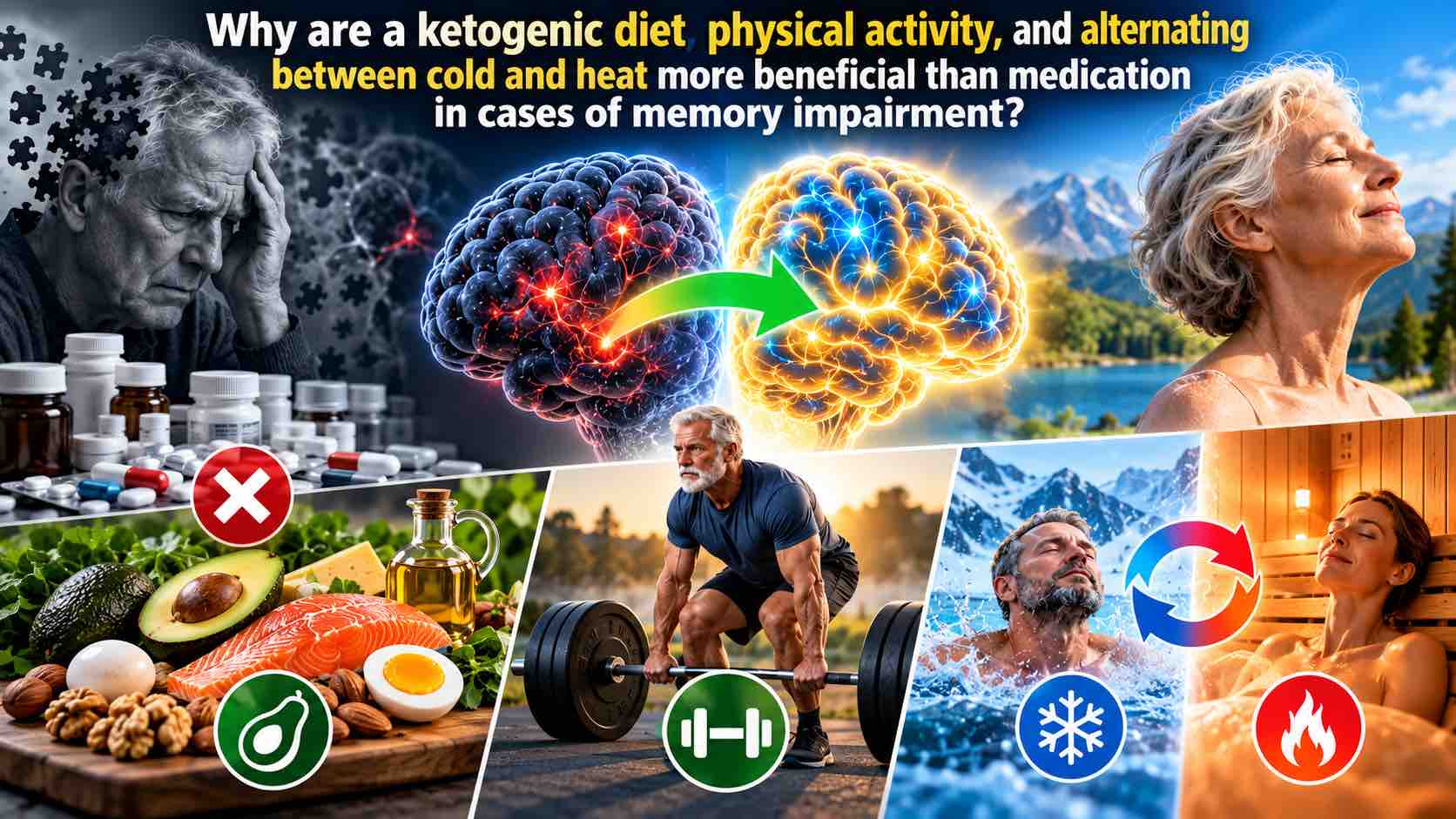

The treatment of Alzheimer’s disease and memory disorders has long focused on medication, yet the results have remained modest. An increasing number of scientific and clinical observations suggest that the root of the problem lies in how the brain utilizes energy. This article examines Alzheimer’s as a metabolic disorder and explains why a ketogenic diet, physical exercise, and alternating between cold and heat may offer more realistic support than pharmaceutical drugs.
Why are a ketogenic diet, physical activity, and alternating between cold and heat more beneficial than medication in cases of memory impairment?
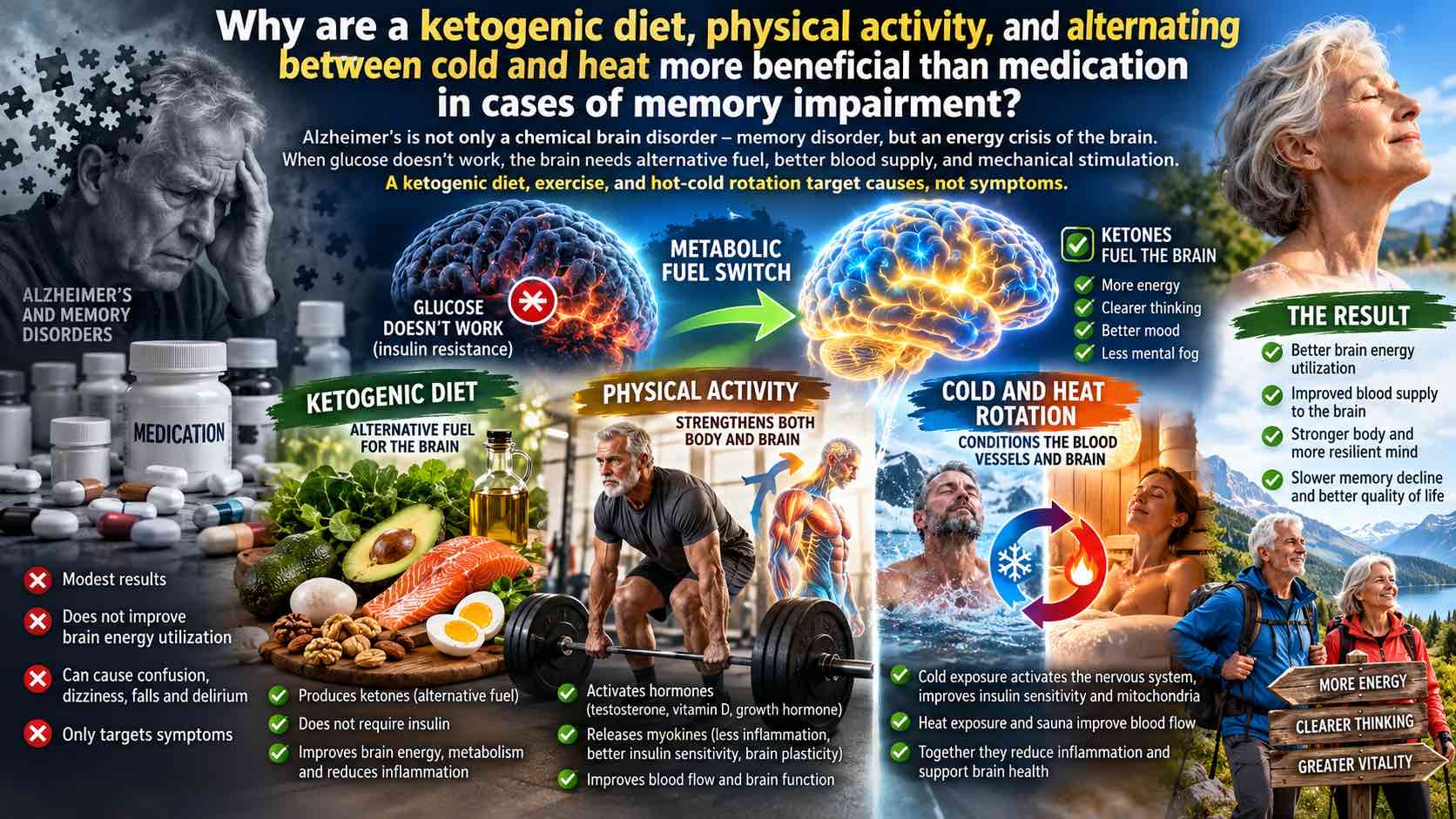
For years, the approach to Alzheimer’s disease and memory disorders has focused on pharmaceuticals. While the promises have been grand, the actual results have been modest. It is becoming increasingly clear that the problem lies not merely in “brain chemistry,” but much deeper—in the brain’s energy utilization and metabolism. This has given rise to a concept frequently cited in scientific literature—though it is not an official medical diagnosis—that characterizes Alzheimer’s as “Type 3 diabetes,” arising from insulin resistance within the brain. Previously, medicine identified Type 2 diabetes as a potential cause of memory disorders; however, it has now been scientifically established that the brain can develop its own distinct form of insulin resistance, which contributes to various chronic conditions. Alzheimer’s is a state in which the brain becomes insulin-resistant regarding glucose, rendering it unable to utilize its primary fuel source.
The ketogenic diet as a metabolic fuel switch.
When the brain cannot derive energy from glucose, it is not merely a case of memory loss in an abstract sense, but rather a genuine energy crisis. A starving brain cannot be restored by a pill that targets a single neurotransmitter; it requires an alternative fuel source, improved blood supply, and functional mitochondria.
In this context, the ketogenic diet becomes a logical choice rather than an ideological one. It is neither a medication nor a mere trend, but a metabolic shift. When carbohydrate intake is low, the body begins to produce ketone bodies—an energy substrate that can cross the blood-brain barrier, does not require insulin, and is capable of fueling the brain even when glucose is no longer effective. While this does not cure Alzheimer’s disease or memory disorders, it does improve the brain’s energy status. Many people report clearer thinking, more stable moods, and a reduction in mental “fog.”
A significant distinction compared to pharmaceutical treatments is that the ketogenic diet does not lead to polypharmacy—a situation where an individual takes an excessive number of medications simultaneously, which may then amplify or interfere with one another’s effects. The ketogenic approach does not introduce new chemical substances into the body, nor does it cause drug interactions; instead, its “side effects” often include improved metabolism, reduced inflammation, and more stable energy levels.
Alternating cold and heat, and conditioning the blood vessels.
Another underrated yet highly powerful intervention is the alternation of cold and heat—specifically, the use of cold water and saunas. Cold exposure is neither torture nor an extreme act, provided it is approached mindfully. For instance, brief sessions in cold water—roughly 3 × 1–2 minutes daily in water at about 8°C—act as a hormetic stimulus. This activates the nervous system, enhances insulin sensitivity and mitochondrial function, and reduces chronic inflammation. When combined with a sauna or other heat exposure, this cold-heat alternation conditions the vascular system and improves blood flow to the brain. The brain is a vascular organ; without healthy blood vessels, no neuron can function—regardless of how “appropriate” a given medication might be.
The brain requires movement, not just pills.
The central role in this entire approach belongs to strength training. Without physical exertion, nothing happens in the brain. Muscles are not merely for movement; they function as endocrine and mechanical organs that directly influence hormones, bone marrow, and brain function. When a muscle pulls on a bone, it creates mechanical tension within that bone. This tension signals to the body that it is worth maintaining, restoring, and strengthening the organism. It is precisely this mechanical signal that keeps testosterone, the functional utilization of vitamin D, and the growth hormone/IGF-1 axis active.
When this signal disappears—due to a sedentary lifestyle, excessive comfort, and a lack of physical load—the body begins to conserve its resources. Hormonal activity declines, muscle and bone tissue degenerate, and brain plasticity diminishes. This is not aging itself; it is a lack of mechanical signaling. Constant comfort is not the pinnacle of well-being; rather, it often acts as an accelerator of the aging process.
Beyond its mechanical impact, muscle also functions as an endocrine organ, releasing myokines that influence inflammation, insulin sensitivity, and brain-derived growth factors. Therefore, strength training is not merely “training the muscles”—it is training the brain through the body. No pill can replicate the hormonal and neurological cascade triggered by active muscles and loaded bones.
Not a miracle cure, but a better option: why the ketogenic diet, physical activity, and hot-cold exposure may be more effective than medication for memory disorders.
If we take an honest look at medications for Alzheimer’s, we must admit that they do not improve the brain’s energy utilization, enhance blood circulation, or strengthen the body. In reality, they often lead to confusion, dizziness, falls, and delirium. A lifestyle-based approach, by contrast, targets the root causes rather than just the symptoms. It works in harmony with the body’s physiology without introducing new risks. In this case, the “side effects” are often improved endurance, greater physical strength, and a clearer mind.
It is important to emphasize that this is not a miracle cure, nor does it promise a full recovery. Instead, it offers something far more realistic: a higher probability that brain function will improve or that the rate of decline will slow down. Very often, this “slight improvement” is far more valuable to the individual and their family than a medication that might show a marginal effect in statistics, yet causes chaos in everyday life.
An Active Choice for Vitality
Ultimately, everything comes down to a single question. It is not about which diet is the “right” one or what temperature of water is the “best.” The question is whether a person wants to give themselves the chance to be full of vitality. A ketogenic diet, physical activity, and alternating between cold and heat do not require permission or a prescription. They only require a decision not to remain passive. And very often, that is precisely where real change begins.
Author Annika Urm – is a financial manager with a master’s degree, whose background in accounting and management has developed a deep understanding of the logic of balance and equilibrium. While studying medical nursing, she discovered that the human body functions on the same principle as a financial balance sheet: health does not depend on individual indicators, but rather on whether the system is in balance.
Annika focuses on the human body as a whole, in which fluid balance, electrolytes, acid-base balance, vitamins, minerals, hormones, and metabolism all play a key role.
Annika takes a systematic approach to health—looking at both test results and the person behind them, and always asking what the body is lacking, what it has in excess, and how to restore balance.
This approach is particularly evident in intensive care, where the patient is unable to speak, and decisions are made based on physiology, test results, and clinical logic. For Annika, this is not an exceptional situation, but a reflection of the fact that everyone’s health ultimately boils down to the same principle—the body’s balance.
In restoring balance, he also considers the regulation of the nervous system and metabolism to be important, where sleep, physical activity (especially strength training), adherence to the circadian rhythm, and the alternation between cold and heat play a central role as physiological signals that teach the body to adapt and recover. In his view, these are not “lifestyle tips,” but rather part of the body’s biological regulation and mechanisms for maintaining health.
In addition to nursing, Annika explores the ketogenic diet as one possible tool for supporting metabolic balance, but her primary interest and passion have always been the same: human health and the body’s ability to heal itself when that balance is in place.
For more information about Annika Urmi, click here:
AU News today https://news.annikaurm.com/
Annika Urm https://annikaurm.com/
Annika Urm – Your Guide to a Healthy Lifestyle
Annika is the creator of Golden Stevia recipes, cookbooks, and a nutrition consultant specializing in keto and low-carb diets, with a focus on low-carb, keto, and diabetes-friendly nutrition. Her approach combines science-based nutrition, practical living, and natural balance
Read more:


